What can we help you find?
Search for masks, machines, accessories...

Sleep Apnea, Night Terrors and Nightmares: The Connection Between Sleep and Drea...

In this article

    Quick Takeaways

    • Sleep apnea can lead to pauses in breathing and drops in oxygen
      levels, which may disrupt sleep and trigger vivid dreams or
      nightmares.1
    • Sleep apnea treatment can help some people experiencing
      nightmares and night terrors through continuous positive airway pressure
      (CPAP).2,13 Lifestyle changes such as stress management and
      healthy sleep habits may help some people with mild sleep
      apnea.3
    • CPAP therapy and other treatments may help restore normal REM
      sleep, which is where most dreaming occurs.4
    • Talk to your doctor if you regularly wake up gasping, sweating,
      or have frightening dreams. These symptoms may be linked to an
      underlying sleep issue, such as sleep apnea.5 Waking up from
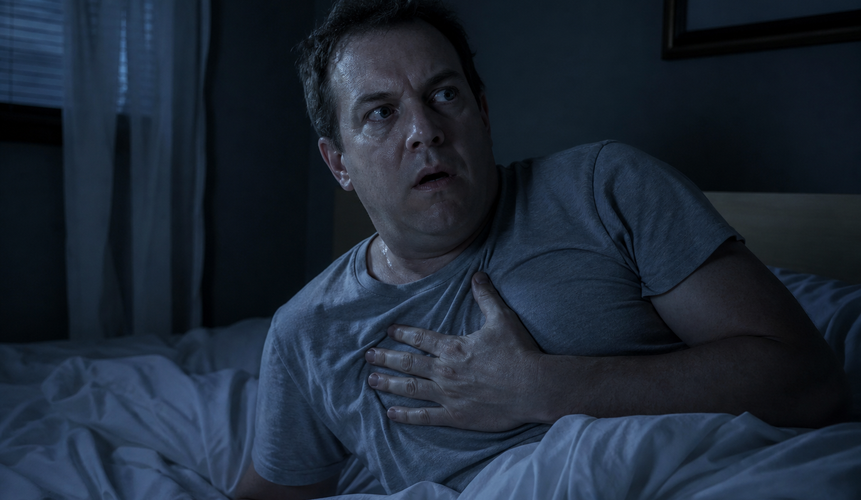
      a nightmare can be a jarring experience. Your heart races, and for a few
      seconds, a sense of panic may linger before you realize you’re in your
      own bed. Nightly disturbances like this can be a sign that you’re
      dealing with more than just bad dreams and may suggest that your body is
      fighting for air.

    If any of this sounds familiar, you might be dealing with something
    experts are starting to understand better: a potential link between
    sleep apnea and nightmares. Learning how breathing can affect your
    dreams is a step toward improving your rest.

    What are nightmares and night terrors?

    The terms nightmare and night terror are often used interchangeably
    in casual conversation, but they’re distinct sleep disorders that tend
    to happen during different stages of sleep.6,7,8

    Nightmares are dreams filled with strong negative emotions or
    abnormal events that can wake you up.9 When this happens, you
    may remember the dream clearly with vivid details. These dreams
    typically occur during stage 4 rapid eye movement (REM) sleep, which is
    characterized by high brain activity that is essential for emotional
    regulation and memory processing.10

    Night terrors are displays of panic or dread that may include crying,
    screaming, thrashing, rapid breathing and open eyes.9
    However, this occurs while a person is sleeping, and they may not
    remember the disturbance the next day. In most cases, night terrors
    happen during stage 3 non-rapid eye movement (NREM) sleep, usually in
    the first third of the night.11

    What is sleep apnea?

    Sleep apnea is a sleep disorder where your breathing repeatedly stops
    and starts during sleep.1 This can make it harder for your
    body to get enough oxygen.

    The most common form is obstructive sleep apnea (OSA), which is where
    the muscles around the throat relax to the point of collapse,
    restricting airflow during sleep.12

    OSA symptoms include:5

    • Excessive daytime sleepiness
    • Morning headaches
    • Feeling irritable or moody
    • Difficulty concentrating or struggling to feel present during the
      day
    • Snoring or gasping for air while you sleep

    Your brain may briefly wake you to help reopen your airway so you can
    start breathing again. These breathing pauses usually happen so quickly
    that many people living with sleep apnea don’t remember them. However,
    these tiny sleep disturbances can greatly impact your sleep quality —
    and is why many people with sleep apnea experience low energy, brain fog
    and daytime tiredness. Additionally, untreated sleep apnea can interfere
    with healthy dream patterns, preventing you from getting the restorative
    rest you need to feel energized and emotionally balanced.

    How sleep apnea affects dreaming

    The relationship between your breath and your dreams is intimate and
    powerful. When your breathing is interrupted, your brain receives a
    distress signal that can dramatically change the content and quality of
    your dreams.13

    Disrupted sleep cycles

    Sleep is a cycle of stages that repeat throughout the
    night.14 People with sleep apnea experience frequent
    awakenings that can interrupt rapid eye movement (REM) sleep — the stage
    associated with dreaming.13,14 Under normal circumstances, a
    person may cycle between non-REM (NREM) sleep and REM sleep every 90 to
    110 minutes. However, the muscle relaxation that causes sleep apnea is
    usually at its worst during REM sleep. This means that just as you drift
    into a dream, your airway may collapse.

    When sleep apnea stops you from spending time in REM sleep, your
    brain may respond by increasing time spent in REM sleep.13
    This can lead to dreams that feel incredibly intense and sometimes
    overwhelming.15

    Oxygen and the brain

    Your brain is very sensitive to changes in oxygen levels. Breathing
    pauses may lead to drops in oxygen, which can trigger a stress response
    in the brain.16 In some cases, this may produce
    anxiety-filled or fearful dreams.17 As oxygen levels fall and
    carbon dioxide builds up, your brain tries to wake up to restore
    airflow.

    That sense of panic can influence your dream narrative. Researchers
    have long noted that the content of nightmares in people with sleep
    apnea often reflects their physical reality.18

    Repeated awakenings can also blur the line between dream and reality,
    leading to confusion or distress upon waking. Because these sleep
    disruptions are often sudden and fueled by a surge of adrenaline (the
    body’s fight or flight hormone), it’s not uncommon to wake up with a
    pounding heart or sense of doom.13 These emotional hangovers
    can linger into the next day, contributing to the anxiety and
    irritability often felt by people living with untreated sleep apnea.

    The role of CPAP and other treatments

    When it comes to nightmares, if the cause is sleep apnea, then
    treating the condition can help provide relief from bad dreams. For some
    people with undiagnosed sleep apnea, the path to more peaceful dreams
    begins with finding the right treatment.

    What is CPAP therapy?

    Continuous positive airway pressure (CPAP) therapy uses a mask that
    fits over your nose and/or mouth, connected to a machine that delivers a
    steady flow of air.20 This air is designed to keep your
    airway open and reduce breathing pauses while you sleep.

    CPAP therapy can help reduce breathing pauses, support healthy oxygen
    levels and restore normal sleep patterns for people with obstructive
    sleep apnea (OSA). By preventing the breathing pauses that disrupt your
    sleep, CPAP allows your brain to cycle naturally
    through light, deep and rapid eye movement (REM) sleep without
    interruption. And when you sleep better, your physical and mental health
    can benefit.21

    With regular use, CPAP therapy may contribute to fewer nightmares,
    calmer dreams and better morning alertness.22,23 While some
    people may experience a temporary increase in dream vividness when they
    first start therapy, this typically settles down as the brain catches up
    on quality sleep.24

    Other treatment options

    While CPAP is the leading treatment for OSA, other options may be
    available.25 It’s up to you and your doctor to decide on a
    treatment plan that best suits you. Other treatments include:

    • APAP and bilevel therapy: APAP automatically
      changes air pressure throughout the night based on your breathing
      patterns. Bilevel therapy uses two pressure settings, one for inhaling
      and a lower one for exhaling. Your doctor will recommend whichever type
      best suits your sleep apnea diagnosis.
    • Oral appliances: These custom-fitted mouthpieces
      are made by a dentist. They hold the jaw slightly forward during sleep
      to keep the airway from narrowing.
    • Surgery: Surgery is typically an option when
      physical differences like enlarged tonsils or a deviated septum is a
      contributing factor. As with any surgery, your doctor will weigh the
      potential benefits against the risks before recommending it.
    • Lifestyle changes: For people with mild sleep
      apnea, lifestyle changes like increasing cardio exercise, losing weight,
      reducing alcohol intake, limiting caffeine intake, managing stress and
      adjusting sleep position may help reduce symptoms.

    When to talk to your doctor

    It’s easy to dismiss bad dreams as a normal part of life, especially
    when we’re stressed. However, certain signs can suggest that your
    nightmares may be a symptom of an underlying health condition like sleep
    apnea.

    Consider speaking to your doctor if you have the following
    symptoms:5

    • You experience frequent nightmares7, gasping
      or choking during sleep.
      If your dreams consistently involve
      themes of struggling to breathe, being underwater or being trapped in
      small spaces, your brain may be reacting to real physical
      sensations.
    • You feel exhausted or irritable despite sleeping through
      the night.
      Waking up feeling unrefreshed, having morning
      headaches or battling excessive daytime sleepiness are signs that your
      sleep quality may be poor, even if you think you slept through the
      night.
    • Your partner notices gasping or pauses in your
      breathing.
      Often, a bed partner is the first to notice the
      signs of sleep apnea. If they report that you stop breathing, gasp for
      air or thrash around in your sleep, take their observations
      seriously.

    A doctor may recommend a sleep test to determine if you have a sleep
    disorder that’s disrupting your rest.19 A sleep test is an
    overnight study used to determine if you have a sleep condition. It
    provides a picture of your health by collecting information such as
    oxygen levels, heart rate, brain waves and breathing patterns while you
    sleep.

    Living well with restful sleep

    The connection between sleep apnea and nightmares highlights how
    deeply our physical health is intertwined with our mental and emotional
    well-being. When you struggle to breathe at night, your mind can
    struggle to find peace. But this connection also offers hope. Getting
    treatment has helped many people with sleep apnea reduce the symptoms
    that come with it.13

    Treating sleep apnea may help reduce nightmares and support more
    positive, restorative dreaming.23 When your brain gets the
    oxygen it needs, it can naturally drift through sleep cycles. This
    allows the brain to perform essential nightly tasks — processing
    memories, regulating emotions and repairing the body — without the
    interruption of a survival alarm.

    Improved oxygen levels and more balanced REM sleep may help you wake
    up feeling more refreshed and focused. For people with obstructive sleep
    apnea, consistent CPAP therapy use can help some people notice more
    restful nights and peaceful dreams.23 Taking care of your
    sleep is an act of self-care that ripples through every hour of your
    waking life.

    Take a 5 minute sleep assessment to learn more about your sleep health.

    References:

    1. Source: Sleep apnea – what is sleep apnea? | nhlbi, nih. (2025, January 9) https://www.nhlbi.nih.gov/health/sleep-apnea
    2. Source: Sun Y, Li J, Zhang X, Jiao Q, Yang S, Ji L. Case Report: Parasomnia Overlap Disorder Induced by Obstructive Sleep Hypopnea Apnea Syndrome: A Case Report and Literature Review. Front Neurosci. 2020 Dec 10;14:578171. doi: 10.3389/fnins.2020.578171
    3. Source: Sleep apnea—Treatment | nhlbi, nih. (2025, January 9) https://www.nhlbi.nih.gov/health/sleep-apnea/treatment
    4. Source: How sleep works—Sleep phases and stages | nhlbi, nih. (2022, March 24) https://www.nhlbi.nih.gov/health/sleep/stages-of-sleep
    5. Source: Sleep apnea—Symptoms | nhlbi, nih. (2025, January 9) https://www.nhlbi.nih.gov/health/sleep-apnea/symptoms
    6. Source: Karna, B., Sankari, A., & Tatikonda, G. (2026). Sleep disorder. In StatPearls. StatPearls Publishing http://www.ncbi.nlm.nih.gov/books/NBK560720/
    7. Source: Van Horn, N. L., & Street, M. (2026). Night terrors(Archived). In StatPearls. StatPearls Publishing http://www.ncbi.nlm.nih.gov/books/NBK493222/
    8. Source: Abenza-Abildúa MJ, Lores-Gutiérrez V, Gutiérrez-Cueto G, Suárez-Gisbert E, Pérez-López C. Howl: Nightmare or REM Sleep Behavior Disorder?. Neurol Clin Pract. 2023;13(1):e200093. doi:10.1212/CPJ.0000000000200093
    9. Source: Nightmares & Other Disturbing Parasomnias. Accessed August 7, 2026 https://aasm.org/resources/factsheets/nightmareparasom.pdf
    10. Source: Goldstein AN, Walker MP. The role of sleep in emotional brain function. Annu Rev Clin Psychol. 2014;10:679-708. doi:10.1146/annurev-clinpsy-032813-153716
    11. Source: Leung AKC, Leung AAM, Wong AHC, Hon KL. Sleep Terrors: An Updated Review. Curr Pediatr Rev. 2020;16(3):176-182. doi:10.2174/1573396315666191014152136
    12. Source: Slowik, J. M., Sankari, A., & Collen, J. F. (2026). Obstructive sleep apnea. In StatPearls. StatPearls Publishing http://www.ncbi.nlm.nih.gov/books/NBK459252/
    13. Source: BaHammam AS, Al-Shimemeri SA, Salama RI, Sharif MM. Clinical and polysomnographic characteristics and response to continuous positive airway pressure therapy in obstructive sleep apnea patients with nightmares. Sleep Med. 2013;14(2):149-154. doi:10.1016/j.sleep.2012.07.007
    14. Source: Patel, A. K., Reddy, V., Shumway, K. R., & Araujo, J. F. (2026). Physiology, sleep stages. In StatPearls. StatPearls Publishing http://www.ncbi.nlm.nih.gov/books/NBK526132/
    15. Source: Feriante, J., & Singh, S. (2026). Rem rebound effect. In StatPearls. StatPearls Publishing http://www.ncbi.nlm.nih.gov/books/NBK560713/
    16. Source: Yang Q, Wang Y, Feng J, Cao J, Chen B. Intermittent hypoxia from obstructive sleep apnea may cause neuronal impairment and dysfunction in central nervous system: the potential roles played by microglia. Neuropsychiatr Dis Treat. 2013;9:1077-86. doi: 10.2147/NDT.S49868. Epub 2013 Aug 5. PMID: 23950649; PMCID: PMC3742344
    17. Source: Fisher, Samantha, et al. “Emotional Content of Dreams in Obstructive Sleep Apnea Hypopnea Syndrome Patients and Sleepy Snorers Attending a Sleep-Disordered Breathing Clinic.” Journal of Clinical Sleep Medicine, vol. 7, no. 1, Feb. 2011, pp. 69–74. Springer Link, https://doi.org/10.5664/jcsm.28043
    18. Source: Schredl M. Dreams in patients with sleep disorders. Sleep Med Rev. 2009 Jun;13(3):215-21. doi: 10.1016/j.smrv.2008.06.002. Epub 2009 Jan 14. PMID: 19147378
    19. Source: Sleep Apnea – Diagnosis | NHLBI, NIH. 9 Jan. 2025, https://www.nhlbi.nih.gov/health/sleep-apnea/diagnosis
    20. Source: CPAP – CPAP | NHLBI, NIH. 24 Mar. 2022, https://www.nhlbi.nih.gov/health/cpap
    21. Source: “Health Benefits of Sleep.” Sleep Foundation, 14 Apr. 2022, https://www.sleepfoundation.org/how-sleep-works/benefits-of-sleep
    22. Source: Carrasco E, Santamria J, Iranzo A, et al. Changes in dreaming induced by CPAP in severe obstructive sleep apnea syndrome patients. Journal of Sleep Research2006;15(4):430-436. doi:10.1111/j.1365-2869.2006.00553.x
    23. Source: Xue P, Zhou J, Lei F, Tan L, Li X, Tang X. Effect of continuous positive airway pressure (CPAP) on mild-moderate obstructive sleep apnea (OSA) related dreaminess: A case report. Medicine (Baltimore). 2020;99(12):e18949. doi:10.1097/MD.0000000000018949
    24. Source: Verma A, Radtke RA, VanLandingham KE, King JH, Husain AM. Slow wave sleep rebound and REM rebound following the first night of treatment with CPAP for sleep apnea: correlation with subjective improvement in sleep quality. Sleep Medicine2001;2(3):215-223. doi:10.1016/S1389-9457(00)00069-1
    25. Source: Gambino F, Zammuto MM, Virzì A, Conti G, Bonsignore MR. Treatment options in obstructive sleep apnea. Intern Emerg Med. 2022;17(4):971-978. doi:10.1007/s11739-022-02983-1

    Stay in the know

    The first name field is required

    The last name field is required

    The email field is required

    Wrong email format

    Please select a Country

    Please make a selection, this field is required