What can we help you find?
Search for masks, machines, accessories...

Can a dentist help with sleep apnea?

Sleep health Dry mouth Seeking care Sleep Apnea

Quick takeaways

  • Dentists can play an important role in screening and treating
    sleep apnea.12
  • Dental appliances like mandibular advancement devices (MADs) and
    tongue-retaining devices (TRDs) may help with mild to moderate
    obstructive sleep apnea (OSA).9
  • Continuous positive airway pressure (CPAP) therapy is the most
    effective method for treating obstructive sleep
    apnea.8
  • Oral appliance therapy may be used in combination with lifestyle
    changes to help treat obstructive sleep apnea
  • Obstructive sleep apnea can only be diagnosed through a sleep
    study by a doctor.14

If you’ve been diagnosed with sleep apnea or are experiencing common
symptoms, such as fatigue or waking up in the middle of the night
gasping for air13, it’s important to have a strong care team
on your side. Sleep apnea is a condition where breathing stops and
restarts many times while you sleep. This can make it harder for your
body to get enough oxygen.1 While sleep apnea should always
be evaluated by a doctor and diagnosed through a sleep study , your
dentist may be able to help with identifying signs, risk factors and
potential treatment options.

The dentist’s role in sleep apnea care

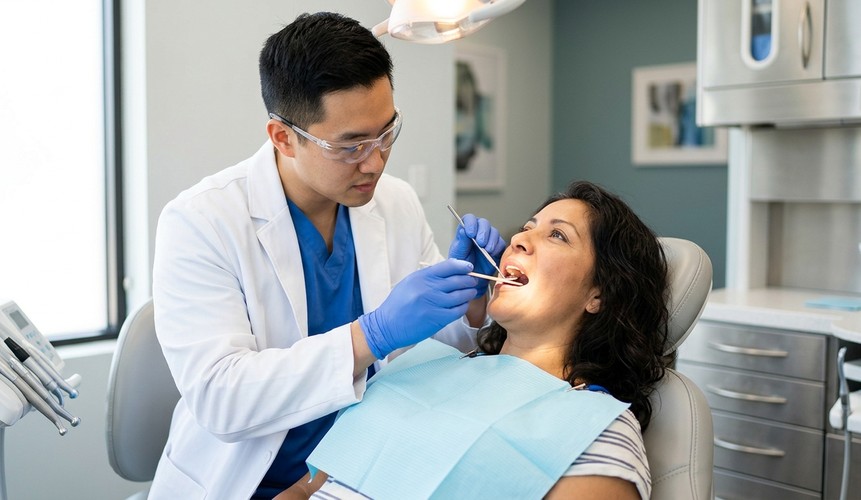
Seeing a dentist for sleep apnea often happens before and after diagnosis. Some people first hear of sleep apnea after a dentist notices flat spots on their teeth due to nighttime grinding. Or a person may mention their loved ones have noticed them snoring, choking or gasping for air in their sleep. Dentists can provide helpful education about the signs, symptoms, and risks of sleep apnea. They may also refer a person to a sleep specialist for a sleep study to help confirm a diagnosis.

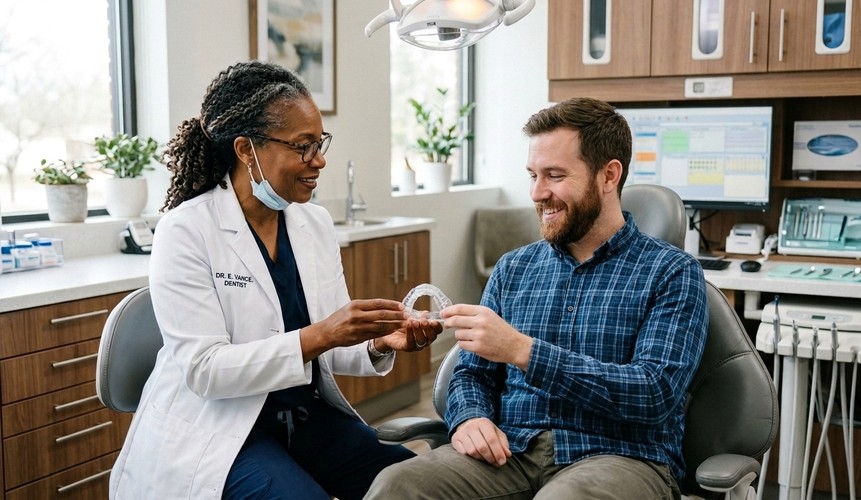
After receiving a sleep apnea diagnosis, a dentist may play a role in your treatment. Dental appliances are designed to reposition the jaw and tongue and may be used to help treat their sleep apnea.9 A trained dentist can help fit and customize these devices.15
 can-dentist-help-sleep-apnea-inpost1
What obstructive sleep apnea (OSA) is and how dentists help spot it

Obstructive sleep apnea is a condition where your upper airway
becomes blocked many times while you sleep. This blockage can reduce or
completely stop the flow of air.1

OSA can affect your physical health and sleep quality, and a dentist
can play a key role in screening for the condition. Many dentists are
trained to look for signs of sleep apnea during checkups, routine
cleanings, or when someone comes in with a specific issue, such as
grinding their teeth.

Dentists may check for OSA by:

  • Looking at soft palate and tongue size.12
  • Checking for jaw alignment and bite problems that can contribute
    to a blocked airway.12
  • Discussing symptoms linked to sleep issues, like
    snoring.12
  • Using imaging to spot possible airway and nasal
    issues.12
  • Looking for signs that you’re grinding your teeth, which can be
    common in adults with OSA.3

Your dentist may also ask questions about the common signs of OSA,
which can include:2

  1. Excessive daytime sleepiness
  2. Morning headaches
  3. Feeling irritable or moody
  4. Difficulty concentrating, struggling to feel present during the
    day
  5. Snoring or gasping for air while you sleep

While a dentist’s evaluation can be helpful in determining if you
have signs of obstructive sleep apnea, a sleep study — whether done in a
lab or at home — is the only way to officially diagnose sleep
apnea.14 A sleep test collects information from your body as
you sleep. Your doctor can use this information to determine if you have
a sleep condition. A home sleep test (HST) can be conveniently completed
from the comfort of your own bed, reducing the amount of time you must
wait to get tested. An in-lab polysomnography (PSG) is usually conducted
overnight in a sleep lab, where a trained lab technician can monitor
your sleep.4 Both are good options for diagnosing OSA.

How dentists and sleep doctors work together

Qualified dentists can be part of your care team for treating
OSA.5 After spotting potential signs of OSA, these dentists
often refer people to sleep doctors who can further evaluate symptoms
and prescribe a sleep study. A qualified dentist can review your sleep
study results to help determine if an oral appliance may be beneficial
in treating OSA.

 can-dentist-help-sleep-apnea-inpost2

Dental treatment options

Below, we explain what oral appliance therapy (OAT) is, the different
device options, and when OAT may be an option for treating obstructive
sleep apnea (OSA).

What is Oral Appliance Therapy (OAT)?

Oral appliance therapy involves using a custom dental device to help
keep the airway open.9 There are two main types of oral
devices:9

  • Mandibular advancement devices (MADs). These are
    designed to move the lower jaw slightly forward to help open the airway.
    They are custom-made for a comfortable fit and can be adjusted if
    needed.
  • Tongue-retaining devices (TRDs). These are
    designed to hold the tongue forward to prevent it from blocking the
    airway.

A dentist can help determine which of these devices may be the right
choice for you and ensure it’s properly fitted. While oral devices may
be an option for people with mild to moderate obstructive sleep apnea,
9 continuous positive airway pressure (CPAP) therapy remains
the most effective sleep apnea treatment.8 CPAP therapy uses
a mask that fits over your nose and/or mouth, connected to a machine
that delivers a steady flow of air. This air is designed to keep your
airway open and reduce breathing pauses while you sleep.7

How effective are dental appliances?

Dental appliances tend to work well for people with mild to moderate
obstructive sleep apnea.9 The severity of sleep apnea is
determined by how many breathing interruptions occur per hour of sleep —
often referred to as AHI (apnea-hypopnea index). Obstructive sleep apnea
is classified into:2

  • Mild: 5 to 14 breathing events per hour
  • Moderate: 15 to 29 breathing events per
    hour
  • Severe: 30 or more breathing events per
    hour

The success of a dental appliance in treating OSA depends on your
body structure, the severity of your sleep apnea, and how consistently
you use the device.9 CPAP is the most effective treatment for
OSA, especially severe OSA,8 and any treatment decision —
including whether to use a dental appliance — should be made under the
guidance of a doctor. A doctor may also recommend follow-up sleep
studies to assess the effectiveness of a dental appliance.

Severe sleep apnea can have serious health consequences if left
untreated. If you think you may have severe sleep apnea, see a doctor
for diagnosis and treatment.

What to consider when treating sleep apnea with a dental appliance

In addition to discussing your situation and care needs with a
doctor, you may also need to consider the following factors when
deciding whether a dental appliance is right for you:

  • Costs. Dental appliances can be expensive, and
    insurance coverage can vary widely. Check with your insurance beforehand
    to find out how much you’re likely to pay for a dental
    appliance.
  • Side effects. Not everyone can tolerate a dental
    appliance. Some people experience side effects like jaw pain, changes in
    their bite, and dry mouth.
  • Adaptation. It can take some time to adjust to
    wearing a dental appliance while sleeping. If you find that it’s
    interrupting your sleep and not becoming more comfortable over time,
    consider discussing other treatment options like continuous positive
    airway pressure (CPAP) therapy with your doctor.
  • Maintenance. Dental appliances are subject to
    wear and tear, and they will need to be replaced eventually. It’s
    important to have regular follow-ups with your dentist to ensure the
    device is working as intended and safe to use.

Your doctor may recommend periodic sleep studies to assess your OSA
symptoms and evaluate the effectiveness of your treatment. If your sleep
apnea doesn’t improve with a dental appliance, changing to CPAP therapy
may lead to better results.15

Lifestyle changes to help improve results

Making lifestyle changes in addition to using a dental appliance or
CPAP therapy for OSA may help improve your results. Your dentist may
provide specific recommendations based on your situation and medical
history, but some of the most helpful lifestyle changes
include:11

  • Weight management. Losing even a small amount of
    weight can help reduce symptoms of OSA.
  • Sleeping on your side. Sleeping on your back
    often worsens OSA symptoms, so changing your sleeping position to your
    side or elevating your head, such as with a wedge pillow, can
    help.
  • Cutting back on alcohol and smoking. Drinking
    alcohol or using tobacco products is a risk factor for OSA, and quitting
    or cutting back can help reduce symptoms.
  • Focusing on a nutritional diet. Eating the right
    foods can play a role in weight management and can promote other health
    benefits. Prioritizing plant-based foods, such as fresh fruits and
    vegetables, and limiting meat and dairy products may help decrease the
    severity and symptoms of OSA.
  • Exercising. Regularly moving your body, such as
    walking or swimming, can improve overall health and potentially decrease
    the severity of obstructive sleep apnea (OSA), even if you don’t lose
    weight. Myofunctional therapy, which involves performing mouth and face
    exercises daily, has also been shown to reduce snoring and improve
    overall quality of life.

If you are having issues with your sleep or a bed partner has
expressed concern about your sleep behaviors, take
our online sleep assessment
and discuss your concerns with a
doctor.

This article is for educational purposes only and is not a substitute
for medical advice. Certain treatment options discussed in this article,
such as CPAP, require a prescription. Always consult with your doctor or
dentist about the best treatment for you.

References:

  1. Source: Sleep Apnea – What Is Sleep Apnea? National Institutes of Health
    (NIH). https://www.nhlbi.nih.gov/health/sleep-apnea
  2. Source: Slowik, J. M., Sankari, A., & Collen, J. F. (2025, March 4).
    Obstructive sleep apnea. StatPearls – NCBI Bookshelf. https://www.ncbi.nlm.nih.gov/books/NBK459252/
  3. Source: Bruxism. National Institutes of Health (NIH).https://www.nidcr.nih.gov/health-info/bruxism
  4. Source: Rosenberg et al., Sleep Med. 2019. https://www.sciencedirect.com/science/article/pii/S1389945718306154?via%3Dihub
  5. Source: American Academy of Dental Sleep Medicine Position on the Scope of
    Practice for Dentists Ordering or Administering Home Sleep Apnea Tests.
    Schwartz et al.https://www.aadsm.org/docs/HSAT_Special_Article_Proof.pdf
  6. Source: The role of oral appliance therapy in obstructive sleep apnoea.
    National Institutes of Health (NIH). https://pmc.ncbi.nlm.nih.gov/articles/pmc10282823/
  7. Source: National Institutes of Health (NIH). https://www.nhlbi.nih.gov/health/cpap
  8. Source: Understanding PAP. Division of Sleep Medicine at Harvard Medical
    School. https://sleep.hms.harvard.edu/education-training/public-education/sleep-and-health-education-program/sleep-health-education-37
  9. Source: Oral Appliances in Obstructive Sleep Apnea. National Institutes of
    Health (NIH).https://pmc.ncbi.nlm.nih.gov/articles/PMC6956298/
  10. Source: Obstructive Sleep Apnea. American Academy of Sleep Medicine. https://aasm.org/resources/factsheets/sleepapnea.pdf
  11. Source: Cultivating Lifestyle Transformations in Obstructive Sleep Apnea.
    National Institutes of Health (NIH).https://pmc.ncbi.nlm.nih.gov/articles/PMC7920220/
  12. Source: Dentists’ role in obstructive sleep apnea: A more comprehensive
    review – ScienceDirect. https://www.sciencedirect.com/science/article/pii/S2667343624000027
  13. Source: Sleep Apnea Symptoms. National Institutes of Health (NIH).
    https://www.nhlbi.nih.gov/health/sleep-apnea/symptoms
  14. Source: Kapur VK et al. Clinical Practice Guideline for Diagnostic Testing
    for Adult Obstructive Sleep Apnea: An American Academy of Sleep Medicine
    Clinical Practice Guideline. J Clin Sleep Med. 2017;13(3):479–504.
    https://pmc.ncbi.nlm.nih.gov/articles/PMC5337595/
  15. Source: Ramar K et al. Clinical Practice Guideline for the Treatment of
    Obstructive Sleep Apnea and Snoring with Oral Appliance Therapy: An
    Update for 2015. J Clin Sleep Med. 2015;11(7):773–827.
    https://pmc.ncbi.nlm.nih.gov/articles/PMC4481062/
  16. Source: Li D et al. Sleep bruxism is highly prevalent in adults with
    obstructive sleep apnea: a large-scale polysomnographic study. J Clin
    Sleep Med. 2023;19(3):443–451. doi: 10.5664/jcsm.10348.
    https://pmc.ncbi.nlm.nih.gov/articles/PMC9978428/

Stay in the know

Be among the first to hear all the latest news and developments.

The first name field is required

The last name field is required

The email field is required

Wrong email format

Please select a Country

Please make a selection, this field is required