What can we help you find?
Search for masks, machines, accessories...

The Tongue and Sleep Apnea: What You Need to Know

Sleep health Sleep Apnea Sleep health Sleep issues

Quick Takeaways:

  • The tongue can contribute to obstructive sleep apnea (OSA) by relaxing or falling backward during sleep. In turn, this can block the airway and cause snoring or breathing pauses.
  • People with larger, fuller tongues or smaller jaws may have a higher risk of tongue-related airway blockage.
  • CPAP therapy is a highly effective treatment for sleep apnea. Options such as oral appliances, tongue-strengthening exercises and certain surgeries may also help some people.
  • Talk with your doctor if you suspect your tongue may be affecting your breathing. A sleep study can confirm whether tongue-related blockages are contributing to your sleep apnea.

The tongue can play a role in obstructive sleep apnea (OSA), potentially making your symptoms worse.1 Many options exist for treating OSA, with continuous positive airway pressure (CPAP) considered the most effective.2

If you’re wondering if your tongue is causing OSA or what treatment options might be best for you, talk with your doctor. They can discuss the process for getting a sleep apnea diagnosis and what treatment options may help.

How the tongue may affect sleep apnea

Your tongue’s position in your mouth can block your airway and may cause you to snore.19

The tongue and your airway

Your tongue is an important part of your upper airway.20 When you sleep, the muscles that hold the tongue in place relax, allowing them to move backward and narrow the airway. For some people, this makes breathing more difficult.

If you have a larger-than-average tongue that extends beyond the ridge line of your teeth, your risk of a tongue-related airway blockage may increase.4 Having a tongue that’s larger than normal is called macroglossia.4 A large tongue is typically something diagnosed by a medical professional. However, if you think your tongue might be making you snore, talk to your doctor.

Why the tongue may block the airway

When you sleep, your muscles relax. That includes the muscles responsible for breathing and the tongue.5 In some cases, this leads to the tongue falling backward, where it can block the airway.

If you have weak tongue or throat muscles, your airway could get partially blocked, leading to sleep apnea symptoms like snoring.6 How the collapse happens depends on the structure of your mouth, tongue and other body structures. Some people may experience a blockage or collapse higher in the throat, while others may experience collapses deeper behind the tongue.21

Risk factors for tongue-related sleep apnea

Studies suggest that enlarged tongues with more fat or muscle may be a risk factor for sleep apnea.7 However, anything that leaves less room for your tongue can be a risk factor. For example, someone with an average-sized tongue but a smaller-than-average jaw or facial structure could be at greater risk. This is because the tongue still lacks room to relax or could fall back into the airway.22

One study looked at whether tongue fat and overall tongue size were related to obstructive sleep apnea.7 Researchers noted that people living with OSA tended to have higher levels of tongue fat, suggesting that tongue size may be associated with OSA risk.7

Another study looked at whether tongue fat was a separate risk factor from obesity.8 It included people living with obesity, with and without sleep apnea. Researchers found that those with sleep apnea were more likely to have extra fat at the base of their tongues, suggesting that larger tongues may be associated with a higher risk for OSA.8

Tongue signs that may suggest sleep apnea

Signs you might be dealing with tongue-related obstructive sleep apnea can include:

  • Scalloped tongue. A tongue that has visible indentations or ripples on the edges is considered scalloped. Some studies suggest that scalloped tongues may be associated with a higher risk of OSA.9,10
  • Tongue ties. With a tongue tie, a bit of tissue keeps your tongue tethered to the bottom of your mouth, restricting movement. The official term for tongue tie is ankyloglossia, and studies indicate that it may be a risk factor for OSA.11
  • Less visibility of the airway. Doctors sometimes use a Mallampati score as a way to define how much of the airway is visible. This is a tool developed to check whether using a breathing tube placed during surgery might be difficult due to a larger-than-normal tongue or other issues. However, if you have variations in tongue or facial structure that impact how much of your airway is visible, it could also indicate a potential risk for OSA.12
How doctors evaluate tongue obstruction

Doctors can use different tools to see if your tongue is blocking your airway and causing sleep problems. They may include:

  • A sleep endoscopy, which shows how the throat functions during light sedation.24
  • Imaging via MRI or CT scans, which can measure the size of the tongue and the amount of fat in the tongue.29
  • Sleep studies to determine if there are airway blockages suggesting possible OSA.24

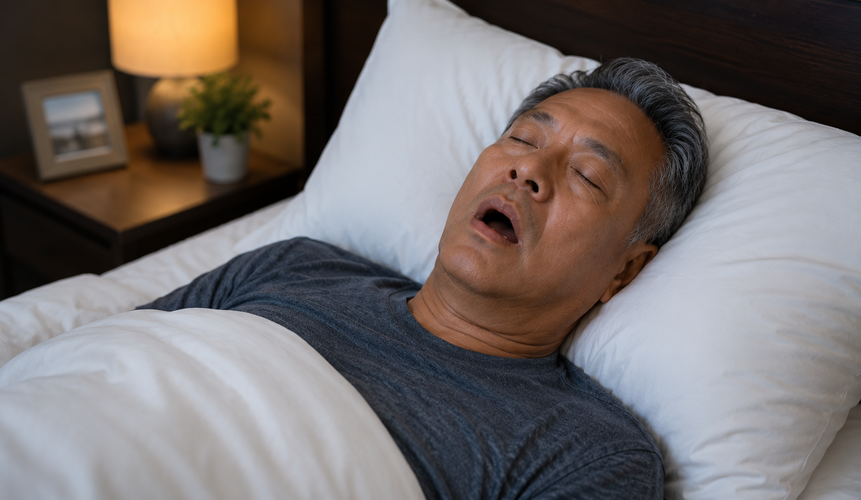
A scalloped tongue, tongue-tie or large tongue may be signs of sleep apnea, but only a sleep study can confirm a diagnosis.
 man-sleeping-mouth-open-in-post

Tongue-Focused Treatment Options

If doctors determine that the tongue is involved in causing obstructive sleep apnea symptoms, they often suggest treatment options that focus on keeping the airway open and repositioning the tongue.

Non-surgical approaches

Continuous positive airway pressure (CPAP) therapy remains the most effective treatment for most people with sleep apnea.2 CPAP therapy is designed to help people with sleep apnea breathe consistently throughout the night.25,26 Small changes, like sleeping on your side, may help reduce blockages related to the tongue. Sleeping on your back can make it easier for the tongue to fall back into the airway, which may contribute to snoring.

Lifestyle changes may also help. For example, weight loss may be associated with lower tongue fat and could ease OSA symptoms.28 Avoiding alcohol at night and cutting out tobacco may also support better sleep quality.15

Oral appliances

Tongue-retaining or stabilizing devices may help some people with sleep apnea. However, results vary and regular follow-up is important.

Oral appliances are available as tongue-retaining devices (TRDs) and mandibular advancement devices (MADs). TRDs hold the tongue forward during sleep, which may help keep the airway more open.23 MADs reposition the lower jaw slightly forward, which may help reduce airway collapse during sleep.

MADs may be useful for people with mild sleep apnea.30 They may also work as a non-surgical alternative to CPAP therapy.16 Proper fitting and follow-up are important to success with oral appliances, and you should always talk through treatment options with your doctor.

Tongue exercises (myofunctional therapy)

Having a weak tongue can make it more likely that the tongue falls back into the airway during the night. That means strengthening the tongue and training it to rest in a different position may be beneficial. Some studies suggest that exercises like tongue pushes, slides and resistance moves may help ease symptoms for people with moderate obstructive sleep apnea.17

Surgical and advanced options

Continuous positive airway pressure (CPAP) is the most researched option for treating sleep apnea. Still, some people may benefit from surgical approaches that target the tongue or airway structure.18 Surgical options may include:

  • Tongue reduction surgery. This procedure removes excess tissue from the tongue to help create more space in the airway. It may lessen the likelihood of airway blockages during sleep.
  • Genioglossus advancement. This moves the main tongue muscles slightly forward. It may help reduce the risk of them collapsing back into the throat and airway.
  • Tongue suspension. This procedure anchors the base of the tongue in place, which may help keep it from falling backward during sleep.27
  • Combination procedures. In some cases, surgeons may combine tongue-focused procedures with other airway surgeries.
 woman-sleeping-in-post

Hypoglossal nerve stimulation


Hypoglossal nerve stimulation is approved for some adults seeking an alternative treatment to CPAP. Your doctor can approve this treatment after appropriate testing and evaluation.

With this treatment, doctors put a small device under the skin. The device sends gentle signals to the nerve controlling the tongue, telling it to move slightly forward. By encouraging the tongue to rest in a more forward position, this treatment may help keep the airway open. This can reduce symptoms like snoring and breathing pauses during sleep. Some studies suggest that hypoglossal nerve stimulation may be associated with reduced OSA symptoms.13,14

Emerging research and options

Studies suggest that cases of obstructive sleep apnea (OSA) are on the rise. Researchers believe that by 2050:3

  • OSA rates among women will increase by 65% (compared to 2025 rates).
  • OSA rates among men will increase by 19% (compared to 2025 rates).
  • These findings highlight the need for ongoing research in diagnosing and treating sleep apnea.

Some emerging research focuses on:

  • Diagnosing sleep apnea more effectively in women.27
  • New devices for tongue training.
  • Medications that target tongue muscles.
  • Improved imaging to personalize treatment approaches.27
Choosing the right treatment

While continuous positive airway pressure (CPAP) is considered an effective treatment for OSA,26 the right option for each person depends on a few factors:

  • Sleep test results: Treatment choice starts with a sleep test, then your doctor can build the treatment plan from those results.
  • How severe the symptoms are: Lifestyle changes such as weight loss and tongue exercises may help people with mild sleep apnea.28
  • The underlying cause of the airway blockage: Factors like obesity and large tongue can narrow the airway. Treatment may change depending on what’s blocking your airways.26
  • Comfort, fit and the ability to use treatment consistently: Long-term success happens for people who use CPAP therapy as prescribed.28 Your doctor can help you adjust mask fit and pressure settings to improve comfort and support regular use.

However you approach treatment, follow-up care is important. Regular check-ins with your doctor can help track how well treatment works and support changes that may lead to better results. Knowing how your tongue may affect OSA can help you work with your doctor to find a treatment that’s right for you.

Are you concerned about your sleep? Learn more with a quick 5-minute sleep assessment.

References:

  1. Source: National Heart, Lung, and Blood Institute. Causes and risk factors of sleep apnea. https://www.nhlbi.nih.gov/health/sleep-apnea/causes
  2. Source: Farré R, Navajas D. Obstructive sleep apnea. In: StatPearls [Internet]. Treasure Island (FL): StatPearls Publishing; 2024. https://www.ncbi.nlm.nih.gov/books/NBK459252/
  3. Source: Boers E, Barrett MA, Benjafield AV, et al. Projecting the 30-year burden of obstructive sleep apnoea in the USA: a prospective modelling study. Lancet Respir Med. 2025;13(12):1078-1086. https://www.thelancet.com/journals/lanres/article/PIIS2213-2600(25)00243-7/abstract
  4. Source: Kutti Sridharan G, Rokkam VR. Macroglossia. In: StatPearls [Internet]. Treasure Island (FL): StatPearls Publishing; [year updated on page]. https://www.ncbi.nlm.nih.gov/books/NBK560545/
  5. Source: Edwards, Bradley A., et al. (2012) Control of the Pharyngeal Musculature During Wakefulness and Sleep: Implications in Normal Controls and Sleep Apnea. https://pmc.ncbi.nlm.nih.gov/articles/PMC3179569/
  6. Source: Brock S. Sleep apnea: causes, symptoms, and treatments. Stanford Lifestyle Medicine. Published October 21, 2025. https://lifestylemedicine.stanford.edu/sleep-apnea/
  7. Source: Baker E, Chanamolu M, Nieri C, White SF, Brandt J, Gillespie MB. The effect of tongue volume and adipose content on obstructive sleep apnea: meta-analysis and systematic review. OTO Open. 2025;9(2):e70067. https://pubmed.ncbi.nlm.nih.gov/40291854/
  8. Source: Kim AM, Keenan BT, Jackson N, Chan EL, Staley B, Poptani H, et al. Tongue fat and its relationship to obstructive sleep apnea. Sleep. 2014;37(10):1639-1648. https://doi.org/10.5665/sleep.4072
  9. Source: Understanding PAP | Sleep Medicine. https://sleep.hms.harvard.edu/education-training/public-education/sleep-and-health-education-program/sleep-health-education-37
  10. Source: Weiss TM, Atanasov S, Calhoun KH. Association of tongue scalloping with obstructive sleep apnea and related sleep pathology. Otolaryngol Head Neck Surg. 2005;133(6):966-971. https://pubmed.ncbi.nlm.nih.gov/16360522/
  11. Source: Bussi, Marieli Timpani, et al. (2022) Is ankyloglossia associated with obstructive sleep apnea? https://pubmed.ncbi.nlm.nih.gov/34895868/
  12. Source: Athayde RAB, Colonna LLI, Schorr F, Gebrim EMMS, Lorenzi-Filho G, Genta PR. Tongue size matters: revisiting the Mallampati classification system in patients with obstructive sleep apnea. J Bras Pneumol. 2023;49(2):e20220402. https://pubmed.ncbi.nlm.nih.gov/37132703/
  13. Source: Woodson BT, Strohl KP, Soose RJ, Gillespie MB, Maurer JT, de Vries N, et al. Upper airway stimulation for obstructive sleep apnea: 5-year outcomes. Otolaryngol Head Neck Surg. 2018;159(1):194-202. https://doi.org/10.1177/0194599818762383
  14. Source: Strollo PJ Jr, Soose RJ, Maurer JT, de Vries N, Cornelius J, Froymovich O, et al. Upper-airway stimulation for obstructive sleep apnea. N Engl J Med. 2014;370(2):139-149. https://pubmed.ncbi.nlm.nih.gov/24401051/
  15. Source: Irish LA, Kline CE, Gunn HE, Buysse DJ, Hall MH. The role of sleep hygiene in promoting public health: a review of empirical evidence. Sleep Med Rev. 2015;22:23-36. https://pmc.ncbi.nlm.nih.gov/articles/PMC4400203/
  16. Source: Ramar K, Dort LC, Katz SG, Lettieri CJ, Harrod CG, Thomas SM, et al. Clinical practice guideline for the treatment of obstructive sleep apnea and snoring with oral appliance therapy: an update for 2015. J Clin Sleep Med. 2015;11(7):773-827. https://pubmed.ncbi.nlm.nih.gov/26094920/
  17. Source: Guimarães KC, Drager LF, Genta PR, Marcondes BF, Lorenzi-Filho G. Effects of oropharyngeal exercises on patients with moderate obstructive sleep apnea syndrome. Am J Respir Crit Care Med. 2009;179(10):962-966. https://pubmed.ncbi.nlm.nih.gov/19234106/
  18. Source: Bettega G, Pépin JL, Veale D, Deschaux C. Obstructive sleep apnea syndrome. Am J Respir Crit Care Med. 2000;162(2):641-649. https://doi.org/10.1164/ajrccm.162.2.9904058
  19. Source: Sleep Foundation. Mouth exercises to stop snoring. https://www.sleepfoundation.org/snoring/mouth-exercises-to-stop-snoring
  20. Source: Cahali MB. Revaluing the role of the tongue in obstructive sleep apnea. J Bras Pneumol. 2019;45(4):e20190208. https://pmc.ncbi.nlm.nih.gov/articles/PMC6733731/
  21. Source: Marques M, Genta PR, Azarbarzin A, Sands SA, Taranto-Montemurro L, Messineo L, et al. Retropalatal and retroglossal airway compliance in patients with obstructive sleep apnea. Respir Physiol Neurobiol. 2018;258:55-61. https://doi.org/10.1016/j.resp.2018.06.008
  22. Source: Chi L, Comyn FL, Mitra N, Reilly MP, Wan F, Maislin G, et al. Identification of craniofacial risk factors for obstructive sleep apnea using three-dimensional MRI. Eur Respir J. 2011;38(2):348-358. https://pmc.ncbi.nlm.nih.gov/articles/PMC4852848/
  23. Source: Lazard DS, Blumen M, Lévy P, Chauvin P, Fragny D, Buchet I, et al. The tongue-retaining device: efficacy and side effects in obstructive sleep apnea syndrome. J Clin Sleep Med. 2009;5(5):431-438. https://pmc.ncbi.nlm.nih.gov/articles/PMC2762714/
  24. Source: Ishman SL, Chang KW, Kennedy AA. Techniques for evaluation and management of tongue-base obstruction in pediatric obstructive sleep apnea. Curr Opin Otolaryngol Head Neck Surg. 2018;26(6):405-411. https://pubmed.ncbi.nlm.nih.gov/30234662/
  25. Source: Understanding PAP | Sleep Medicine. https://sleep.hms.harvard.edu/education-training/public-education/sleep-and-health-education-program/sleep-health-education-37
  26. Source: Summer JV. Before and after CPAP: how your body changes. Sleep Foundation. 2025. Accessed March 2, 2026. https://www.sleepfoundation.org/cpap/before-and-after-cpap-machine-body-changes
  27. Source: Kocdor P, Froymovich O, Mickelson SA. Tongue base suspension procedures for obstructive sleep apnea syndrome. Oper Tech Otolaryngol Head Neck Surg. 2015;26(4):243-247. https://doi.org/10.1016/j.otot.2015.07.002
  28. Source: Pleava R, Mihaicuta S, Serban CL, Ardelean C, Marincu I, Gaita D, et al. Long-term effects of continuous positive airway pressure (CPAP) therapy on obesity and cardiovascular comorbidities in patients with obstructive sleep apnea and resistant hypertension: an observational study. J Clin Med. 2020;9(9):2802. https://pmc.ncbi.nlm.nih.gov/articles/PMC7564990/
  29. Source: Wang SH, Keenan BT, Wiemken A, Zang Y, Staley B, Sarwer DB, et al. Effect of weight loss on upper airway anatomy and the apnea-hypopnea index: the importance of tongue fat. Am J Respir Crit Care Med. 2020;201(6):718-727. https://doi.org/10.1164/rccm.201903-0692OC
  30. Source: Vecchierini Marie Françoise et al. Mandibular Advancement Device Use in Obstructive Sleep Apnea ORCADES Study 5 Year Follow up Data Journal of Clinical Sleep Medicine JCSM Official Publication of the American Academy of Sleep Medicine vol 17 no 8 Aug 2021 pp 1695–705 PubMed https://doi.org/10.5664/jcsm.9308

Stay in the know

Be among the first to hear all the latest news and developments.

The first name field is required

The last name field is required

The email field is required

Wrong email format

Please select a Country

Please make a selection, this field is required