Mouth Guards for Sleep Apnea: Benefits and How They Work | Resmed
What can we help you find?
Search for masks, machines, accessories...

Mouth Guards for Sleep Apnea: Benefits and How They Work

Sleep health Fatigue PAP therapy Sleep health Sleep issues

Mouth Guards for Sleep Apnea: Benefits and How They Work

Quick Takeaways

  • Mouth guards for sleep apnea (also called oral appliances) help keep the airway open by gently moving the jaw or tongue forward during sleep.
  • Two main types: mandibular advancement devices (MADs) and tongue retaining devices (TRDs); both can be intended to reduce snoring and mild to moderate OSA symptoms.
  • Custom-fit devices prescribed by a doctor and adjusted by a dentist tend to provide the most comfortable and effective results.1
  • Mouth guards are an effective alternative to treat OSA, even if CPAP remains the most effective treatment for more people.2 But they can be used in combination in select cases.

Obstructive sleep apnea (OSA) is a condition where breathing repeatedly stops and starts due to blocked airways during sleep. Left untreated, OSA can impact nearly every part of your life. It’s linked to serious health concerns like high blood pressure, heart disease and diabetes.3

Beyond physical health, sleep apnea can also lead to daytime fatigue, low mood and memory issues that impact your work or social activities.4 In fact, around 32% of people in romantic relationships say that their partner’s snoring or other symptoms associated with obstructive sleep apnea make it harder to sleep.5

For some people with obstructive sleep apnea, mouth guards are a portable, non-invasive treatment option. Explore what sleep apnea mouth guards are, how they work and what to know before using one below.

What are mouth guards?

Sleep apnea mouth guards are also called oral appliances for sleep apnea. They’re designed to keep your airway open while you sleep.

Many people are familiar with dental night guards, which help protect your teeth from grinding while sleeping. In contrast, oral devices for sleep apnea are designed to help reduce pauses in breathing that lead to OSA symptoms like gasping or choking while sleeping.

Two main types of sleep apnea mouth guards are mandibular advancement devices (MADs) and tongue retaining devices (TRDs). Both devices are made from medical-grade materials, such as silicone, acrylic or thermoplastic to support safety, durability and comfort.
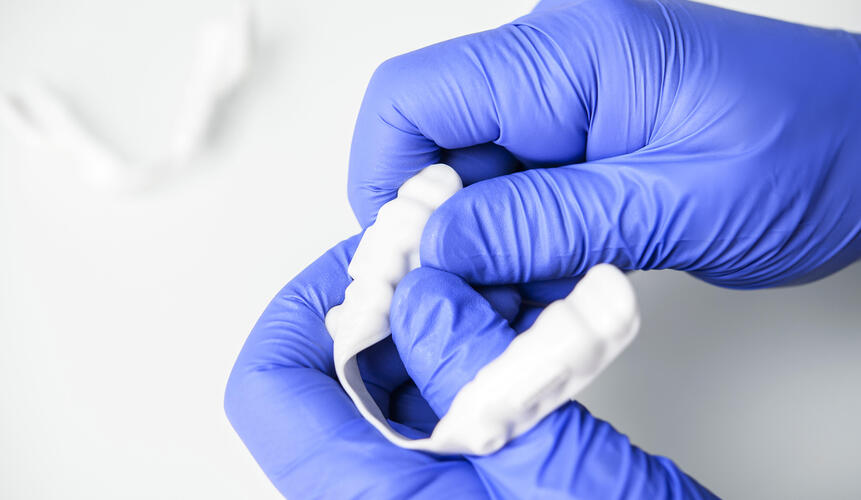
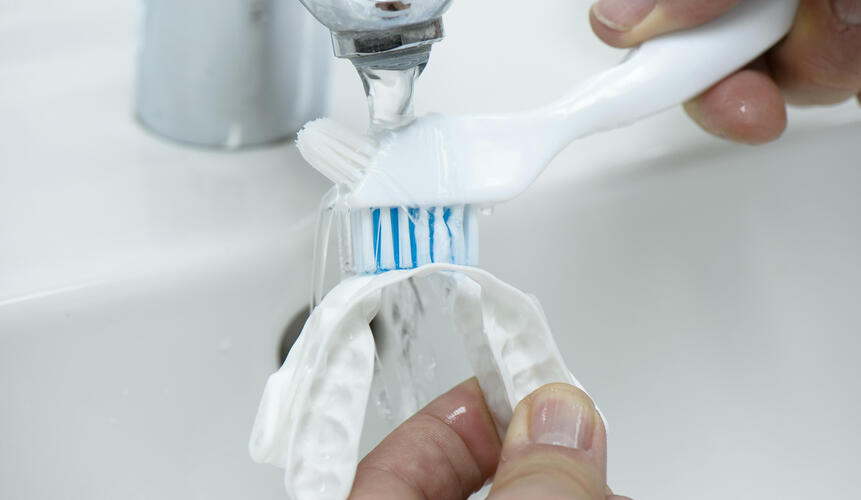
 mouth guard
How do mouth guards help treat obstructive sleep apnea (OSA)?

Mouth guards for obstructive sleep apnea work by gently guiding your jaw or tongue forward. This motion helps keep your airway open as you sleep. Keeping your airway open helps you breathe easier, sleep more soundly and wake up less often during the night.

MADs pull the lower jaw forward, helping to better position the tongue, soft palate and uvula. This helps reduce the chance they collapse back and block the airway. TRDs use a gentle suction to hold the tongue forward and away from the back of the throat.

The goal of both devices is to help keep your airway open while you sleep. This makes it easier to breathe, improves sleep quality and reduces OSA symptoms like snoring. It also helps support better breathing patterns during sleep.

Types of mouth guards for obstructive sleep apnea

Sleep apnea oral appliances come in two major types: MADs and TRDs. The device that works best for you depends on your jaw structure, personal preference and other factors.

Mandibular advancement devices (MADs)

MADs are the most common sleep apnea oral appliance. These treatment options gently shift the lower jaw forward to open the airway and ease breathing.

The devices are adjustable and custom-fit, which means they allow precise changes in jaw positioning. The ability to make small changes helps create a fit that’s comfortable and effective.

MADs work by gently pulling the lower jaw (mandible) forward. The tongue and soft tissues in the mouth also shift forward, making more room in your throat for air to flow. In a recent study, up to 63% of participants using MADs reported that they stopped snoring6 due to a more open airway.

For a mandibular advancement device to be effective, the bottom and top pieces need to fit comfortably. A sleep specialist can write a prescription for the device. From there, a trained dentist can make adjustments to ensure the new device is comfortable and fits your mouth correctly.

Tongue retaining devices (TRDs)

TRDs work by holding the tongue forward in the mouth via gentle suction. As with MADs, the device helps keep the airway open by bringing the tongue and soft tissue forward. While MADs shift the lower jaw forward, TRDs keep the jaw still and focus on moving the tongue forward to keep your airways open while you sleep.

TRDs may be an option for people with sleep apnea who:

  • Prefer not to adjust their jaw due to other dental or health concerns.
  • Feel discomfort when their jaw is moved.
  • Don’t have strong enough teeth for a mandibular advancement device, as MADs are held in place partly by teeth.
 mouthguard-for-sleep-apnea-benefits-and-how-they-work
What to consider before using a mouth guard

When considering a MAD or TRD for sleep apnea, it’s important to research treatment effectiveness, cost and other factors.

Effectiveness and treatment outcomes

Many people considering sleep apnea mouth guards want to know if they can replace continuous positive airway pressure (CPAP) therapy. Deciding on a treatment can vary based on many factors and should be made with a doctor.

Studies have compared health outcomes between CPAP and MAD use in obstructive sleep apnea (OSA) treatment. CPAP is widely recognized as the first-line therapy, particularly for patients with complex comorbidities.7 MADs, on the other hand, are often associated with higher adherence rates.5

One study found that after two years, both MADs and CPAP were effective in treating sleep apnea. However, CPAP worked better at helping people get more oxygen while they sleep and at reducing how often their breathing stops or becomes shallow.9

Diagnosis and getting started

Oral appliances can sometimes be used to treat obstructive sleep apnea (OSA). OSA is diagnosed with a sleep test — either at home or overnight in a lab. After taking a sleep test, you and your doctor can review the results and, if diagnosed with OSA, determine the best treatment option.

If you and your doctor determine that an oral appliance is appropriate, a dentist will take dental impressions. This can be done with a physical mold or digital scans. The goal is to determine how far forward your jaw needs to move to support comfort and effective OSA treatment.

Next, a custom oral device is made. During fittings, the device is adjusted to fine-tune your jaw position. Once you start sleeping with your mouth guard, you’ll want to follow up with your dentist. During these check-ins, your dentist can make sure your device is properly fitted and effectively treating your OSA.

Side effects and comfort considerations

The most common side effect when using an oral appliance for sleep apnea can be mild discomfort. That may include jaw soreness, tenderness in the mouth, dry mouth or excessive salivation. Often, these minor irritations only occur in the first few weeks as people get used to the mouth guard.10

Long-term issues are rare but can include tooth movement, ongoing discomfort in the jaw and changes in your bite.10 Regular follow-ups with your dentist can help catch these problems early. Adjustments to the device can support a comfortable fit and encourage consistent use.

People who use sleep apnea mouth guards tend to have better experiences when the devices fit properly and are comfortable. Regular follow-ups can help fine-tune the device’s fit and address any discomfort or changes.

Mouth guards as part of comprehensive obstructive sleep apnea treatment

Mouth guards and CPAP are not used together at the same time. But mouth guards and other therapies like positional therapy or weight management strategies can be used together.

Because obstructive sleep apnea (OSA) can evolve over time, follow-ups are needed to ensure treatment is still efficiently reducing the frequency of breathing pauses during sleep. They can help check whether a mouth guard is effectively controlling symptoms and provide data that guides necessary adjustments.

If you’re ready to learn more about your sleep health, take our sleep assessment today.

References
  1. Source: Johal Ama et al Ready-Made Versus Custom-Made Mandibular Repositioning Devices in Sleep Apnea A Randomized Clinical Trial Journal of Clinical Sleep Medicine JCSM Official Publication of the American Academy of Sleep Medicine vol 13 no 2 Feb 2017 pp 175–82 PubMed https://doi.org/10.5664/jcsm.6440
  2. Source: Cao Michelle T et al Continuous Positive Airway Pressure Therapy in Obstuctive Sleep Apnea Benefits and Alternatives Expert Review of Respiratory Medicine vol 11 no 4 Apr 2017 pp 259–72 PubMed https://doi.org/10.1080/17476348.2017.1305893
  3. Source: Knauert Melissa et al Clinical Consequences and Economic Costs of Untreated Obstructive Sleep Apnea Syndrome World Journal of Otorhinolaryngology Head and Neck Surgery vol 1 no 1 Sept 2015 pp 17–27 PubMed https://doi.org/10.1016/j.wjorl.2015.08.001
  4. Source: Kerner Nancy A and Steven P Roose Obstructive Sleep Apnea Is Linked to Depression and Cognitive Impairment Evidence and Potential Mechanisms The American Journal of Geriatric Psychiatry Official Journal of the American Association for Geriatric Psychiatry vol 24 no 6 June 2016 pp 496–508 PubMed Central https://doi.org/10.1016/j.jagp.2016.01.134
  5. Source: Resmeds 2025 Global Sleep Survey https://sleepsurvey.resmed.com/
  6. Source: Vecchierini Marie Françoise et al Mandibular Advancement Device Use in Obstructive Sleep Apnea ORCADES Study 5 Year Follow up Data Journal of Clinical Sleep Medicine JCSM Official Publication of the American Academy of Sleep Medicine vol 17 no 8 Aug 2021 pp 1695–705 PubMed https://doi.org/10.5664/jcsm.9308
  7. Source: Understanding Pap 2021 Division of Sleep Medicine at Harvard Medical School https://sleep.hms.harvard.edu/education-training/public-education/sleep-and-health-education-program/sleep-health-education-37
  8. Source: Basyuni Shadi et al An Update on Mandibular Advancement Devices for the Treatment of Obstructive Sleep Apnoea Hypopnoea Syndrome Journal of Thoracic Disease vol 10 no Suppl 1 Jan 2018 https://doi.org/10.21037/jtd.2017.12.18
  9. Source: Doff Michiel H J et al Oral Appliance Versus Continuous Positive Airway Pressure in Obstructive Sleep Apnea Syndrome A 2 Year Follow Up Sleep vol 36 no 9 Sept 2013 pp 1289–96 PubMed Central https://doi.org/10.5665/sleep.2948
  10. Source: Dieltjens Marijke and Olivier M Vanderveken Oral Appliances in Obstructive Sleep Apnea Healthcare vol 7 no 4 Nov 2019 p 141 PubMed Central https://doi.org/10.3390/healthcare7040141