Stroke risk
Among people who’ve experienced a stroke, over 7 in 10 had moderate to severe obstructive sleep apnea (OSA).18 When people with OSA experience drops in blood oxygen levels, the body activates stress responses that can raise blood pressure — a factor linked to higher stroke risk.
Over time, repeated oxygen level changes associated with OSA may affect brain function and have been linked to transient ischemic attacks (mini strokes).19 These effects may increase the risk of permanent brain damage and a full ischemic stroke.
Several studies have shown a higher rate of stroke among people with OSA compared to the general population. Researchers observed a 1.5-fold increased risk of stroke in those with OSA compared to those without the disorder.20
Other serious health complications
Apart from heart conditions and stroke, individuals living with OSA may face other health complications. For example, 72% of people with Type 2 diabetes also have OSA.22 There is also a link between OSA and weight management — an estimated 77% of people with OSA also have obesity.23
A consistent lack of oxygen due to OSA may affect vital organs, including the brain, heart and kidneys. It has also been linked to memory impairment and mental health concerns such as anxiety and depression,24 indirectly increasing the risk of complications.
Impact on life expectancy
Without treatment, obstructive sleep apnea (OSA) has been linked to a shorter lifespan. In one study, about 1 in 3 individuals with moderate to severe OSA died over a 14-year period. By comparison, only about 1 in 15 people without OSA died.25
The more severe the OSA, the higher the impact it can have on a person’s lifespan. In fact, moderate to severe OSA is associated with a six-fold higher overall mortality rate.26
Fortunately, life expectancy can improve with the right treatment. People with OSA who use continuous positive airway pressure (CPAP) — a treatment that uses gentle, steady air pressure through a mask to keep your airway open while you sleep — for 5 or more years have reduced mortality.7 They also have a decreased risk of developing conditions like heart disease and Type 2 diabetes.27
Risk factors that increase mortality danger
While sleep apnea (OSA) on its own can be serious, having other health conditions at the same time may further increase overall health risks. Excess body weight, particularly around the neck, can put added pressure on the upper airways — making them more likely to collapse.28 Lifestyle habits, such as a poor diet, smoking and limited physical activity, can also contribute to higher mortality risks in people with OSA.27
Age can also play a role in overall health. In one study, researchers found that older adults with OSA and daytime sleepiness had more than twice the likelihood of death compared to younger individuals without OSA.29
Treatment and improved health outcomes
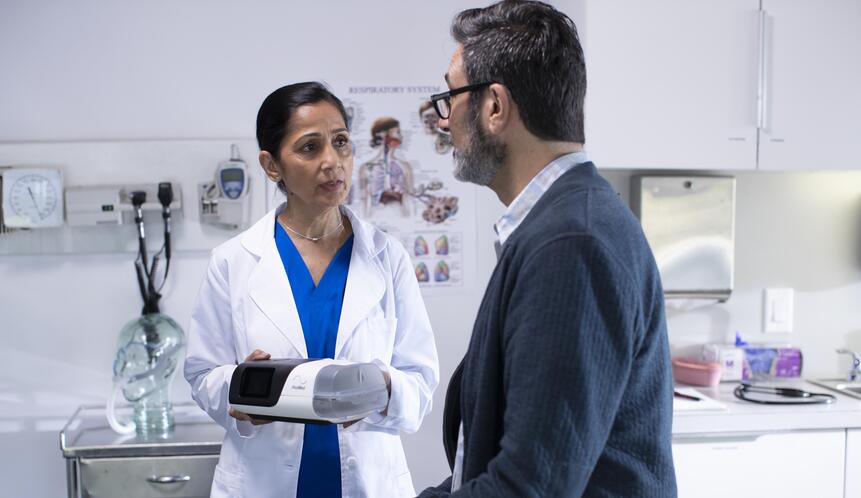
The good news is that with proper diagnosis and treatment, individuals with OSA can live long, healthy lives. One approach is CPAP therapy — the most used and effective method for treating sleep apnea.30
CPAP works by pushing gentle, pressurized air through a mask worn over the mouth or nose (or both). This constant stream of air helps keep the airway open during the night, preventing the airways from collapsing.
When used as directed, some people with sleep apnea may experience symptom relief after their first night of using CPAP.10 Plus, some people who consistently use their CPAP may see a reduced rate of cardiovascular events and a better quality of life.31,32
Research also shows that CPAP therapy may help people with OSA live longer. In one study, CPAP use was associated with a 37% lower overall mortality risk and a 55% lower risk of heart-related death.7
Concerned about your sleep? Learn more about the quality of your sleep by taking our sleep assessment.
Resources
- Source: National Heart, Lung, and Blood Institute. What is sleep apnea? Updated 2025. Accessed March 2, 2026. https://www.nhlbi.nih.gov/health/sleep-apnea
- Source: Harvard Medical School, Division of Sleep Medicine. Understanding the results. Published 2021. Accessed March 2, 2026. https://sleep.hms.harvard.edu/education-training/public-education/sleep-and-health-educationprogram/sleep-health-education-34
- Source: Summer JV. Normal oxygen levels while sleeping. Sleep Foundation. July 15, 2025. Accessed March 2, 2026. https://www.sleepfoundation.org/physical-health/what-are-normal-oxygen-levels-during-sleep
- Source: Bonsignore MR, et al. Obstructive sleep apnea and comorbidities: a dangerous liaison. Multidiscip Respir Med. 2019;14:8. doi:10.1186/s40248-019-0172-9
- Source: Laratta CR, et al. Diagnosis and treatment of obstructive sleep apnea in adults. CMAJ. 2017;189(48):E1481-E1488. doi:10.1503/cmaj.170296
- Source: Gottlieb DJ, et al. Sleep deficiency and motor vehicle crash risk in the general population: a prospective cohort study. BMC Med. 2018;16(1):44. doi:10.1186/s12916-018-1025-7
- Source: Benjafield AV, et al. Positive airway pressure therapy and all-cause and cardiovascular mortality in people with obstructive sleep apnoea: a systematic review and meta-analysis of randomised controlled trials and confounder-adjusted, non-randomised controlled studies. Lancet Respir Med. 2025;13(5):403-413. doi:10.1016/S2213-2600(25)00002-5
- Source: Cheng AC, et al. Effect of obstructive sleep apnea on the risk of injuries—a nationwide population-based cohort study. Int J Environ Res Public Health. 2021;18(24):13416. doi:10.3390/ijerph182413416
- Source: O’Carroll G, et al. Can you die from obstructive sleep apnoea syndrome (OSAS)? Ir Med J. 2015;108(2):40-43. pubmed.ncbi.nlm.nih.gov/25803953/
- Source: Yu L, Shu L, Gao S, Li L. CPAP improves sleep stability and attenuates acute nocturnal hypertension (NBPF) in OSA, with maximal benefits in severe cases. Front Neurol. 2025;16:1587127. doi:10.3389/fneur.2025.1587127. PMID: 40692557; PMCID: PMC12277164
- Source: Qiu Y, et al. Association of obstructive sleep apnea with cardiovascular events in acute coronary syndrome patients with or without excessive daytime sleepiness: a prospective cohort study. Rev Cardiovasc Med. 2025;26(7):33439. pmc.ncbi.nlm.nih.gov/articles/PMC12326451/
- Source: DiCaro MV, et al. The effects of obstructive sleep apnea on the cardiovascular system: a comprehensive review. J Clin Med. 2024;13(11):jcm13113223. pmc.ncbi.nlm.nih.gov/articles/PMC11172971/
- Source: Sheikh M, Kuperberg S. An organ systems-based review of outcomes associated with sleep apnea in hospitalized patients. Medicine (Baltimore). 2021;100(34):e26857. pmc.ncbi.nlm.nih.gov/articles/PMC8389950
- Source: Yeghiazarians Y, et al. Obstructive sleep apnea and cardiovascular disease: a scientific statement from the American Heart Association. Circulation. 2021;144(3):e56-e67. doi:10.1161/CIR.0000000000000988. pubmed.ncbi.nlm.nih.gov/34148375/
- Source: Peppard PE, et al. Prospective study of the association between sleep-disordered breathing and hypertension. N Engl J Med. 2000;342(19):1378-1384. pubmed.ncbi.nlm.nih.gov/10805822/
- Source: Menon T, et al. Sleep-disordered breathing and cardiac arrhythmias. J Clin Med. 2024;13(22). doi:10.3390/jcm13226635. pmc.ncbi.nlm.nih.gov/articles/PMC11595083/
- Source: Christensen T. Severe sleep apnea could damage key blood vessels. American Heart Association News. July 26, 2021. https://www.heart.org/en/news/2021/07/26/severe-sleep-apnea-coulddamage-key-blood-vessels
- Source: Johnson KG, Johnson DC. Frequency of sleep apnea in stroke and TIA patients: a meta-analysis. J Clin Sleep Med. 2010;6(2):131-137.
- Source: Bassetti C, et al. Sleep apnea in patients with transient ischemic attack and stroke: a prospective study of 59 patients. Neurology. 1996;47(5):1167-1173. pubmed.ncbi.nlm.nih.gov/8909424/
- Source: Lamberts M, et al. Cardiovascular risk in patients with sleep apnoea with or without continuous positive airway pressure therapy: follow-up of 4.5 million Danish adults. J Intern Med. 2014;276(6):659-666. pubmed.ncbi.nlm.nih.gov/25169419/
- Source: Lin HJ, et al. Increasing and high prevalence of moderate to severe obstructive sleep apnea in acute ischemic stroke in Taiwan. J Formos Med Assoc. 2024;123(3):408-414. pubmed.ncbi.nlm.nih.gov/37770283/
- Source: Einhorn D, et al. Prevalence of sleep apnea in a population of adults with type 2 diabetes mellitus. Endocr Pract. 2007;13(4):355-362. pubmed.ncbi.nlm.nih.gov/17669711/
- Source: O’Keeffe T, Patterson EJ. Evidence supporting routine polysomnography before bariatric surgery. Obes Surg. 2004;14:23-26. doi:10.1381/096089204772787248
- Source: Kim JY, Ko I, Kim DK. Association of obstructive sleep apnea with the risk of affective disorders. JAMA Otolaryngol Head Neck Surg. 2019;145(11):1020-1026. jamanetwork.com/journals/jamaotolaryngology/fullarticle/2749521
- Source: Marshall NS, et al. Sleep apnea as an independent risk factor for all-cause mortality: the Busselton Health Study. Sleep. 2008;31(8):1079-1085. pmc.ncbi.nlm.nih.gov/articles/PMC2542953/
- Source: Dodds S, et al. Mortality and morbidity in obstructive sleep apnoea–hypopnoea syndrome: results from a 30-year prospective cohort study. ERJ Open Res. 2020;6(3):00057-2020. doi:10.1183/23120541.00057-2020. pmc.ncbi.nlm.nih.gov/articles/PMC7487348/
- Source: Melaku YA, et al. Healthy lifestyle is associated with reduced cardiovascular disease, depression and mortality in people at elevated risk of sleep apnea. J Sleep Res. 2024;33(4):e14069. doi:10.1111/jsr.14069
- Source: Jehan S, et al. Obstructive sleep apnea and obesity: implications for public health. Sleep Med Disord. 2017;1(4):00019. https://www.ncbi.nlm.nih.gov/pmc/articles/PMC5836788/
- Source: McStay E. Risk of death is high in older adults with sleep apnea and daytime sleepiness. American Academy of Sleep Medicine. March 29, 2011. https://aasm.org/risk-of-death-is-high-in-older-adultswith-sleep-apnea-and-daytime-sleepiness/
- Source: Harvard Medical School, Division of Sleep Medicine. Understanding PAP. Accessed March 2, 2026. https://sleep.hms.harvard.edu/education-training/publiceducation/sleep-and-health-education-program/sleep-health-education-37
- Source: Summer JV. Before and after CPAP: how your body changes. Sleep Foundation. 2025. Accessed March 2, 2026. https://www.sleepfoundation.org/cpap/before-and-after-cpap-machine-body-changes
- Source: Djonlagic I, et al. First night of CPAP: impact on memory consolidation, attention and subjective experience. Sleep Med. 2015;16(6):697-702. doi:10.1016/j.sleep.2015.01.017