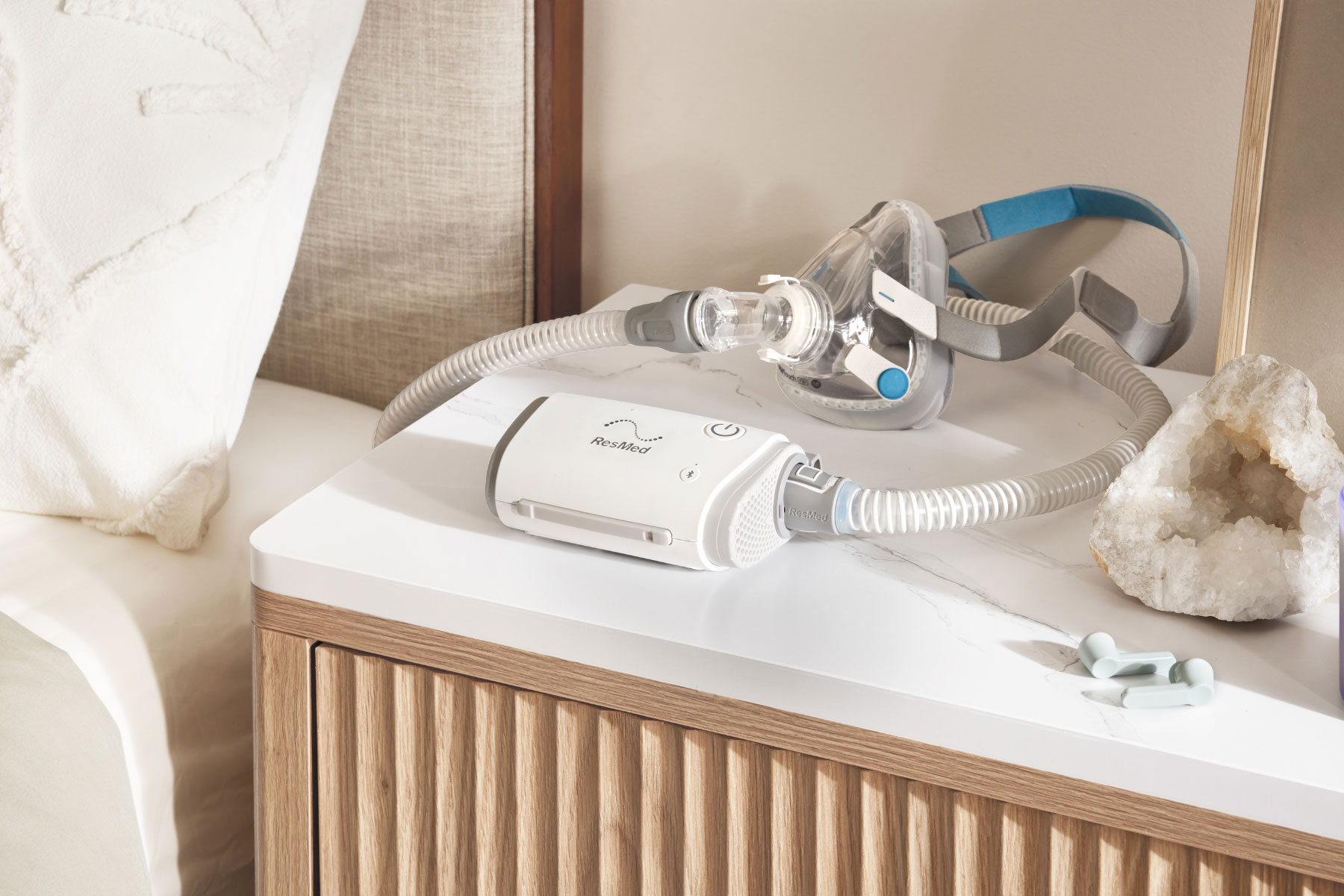
When it comes to noninvasive ventilation (NIV), ResMed can help ensure that your patients are receiving the right support for each breath. ResMed NIV products contain powerful synchronization technologies that enable the patient to remain comfortable and well-ventilated, reducing the work of breathing. Vsync leak compensation and breath customization features help to ensure that ResMed NIV devices respond to every patient breath to help achieve better therapy outcomes.
Like all forms of mechanical ventilation, NIV has two key goals. It improves the exchange of oxygen and carbon dioxide between the patient’s blood and the air in their lungs. It also supports the work of breathing when the patient’s own physiology is ineffective.
To achieve these goals, the essential functions include delivering the right inspiratory and expiratory pressures to support the patient’s ventilatory demand, enhancing alveolar minute ventilation, maintaining upper airway patency and recruiting collapsed alveoli.
Superior synchronization technology protects every breath1-2
Comfortable and easy to use for patients
1 Gentile. Cycling of the mechanical ventilator breath. Respir Care 2011.
2 Berry et al. Best clinical practice for the sleep center adjustment of noninvasive positive pressure ventilation in stable chronic alveolar hypoventilation syndromes. J Clin Sleep Med 2010.
S9 VPAP ST-A with iVAPS
Intelligent. Personalized. Automatic.
iVAPS is ResMed’s intelligent Volume-Assured Pressure Support featured in the S9 VPAP ST-A. It monitors ventilation and adjusts to a patient's respiratory rate, targets and maintains alveolar ventilation, and automatically adjusts Pressure Support as needed to accommodate each patient's unique needs, even as position or sleep stage changes occur or as disease states progress.
Intelligent: Unlike other ventilation modes that only target tidal volume, iVAPS targets alveolar ventilation, accounting for anatomical dead space to ventilate the patient more effectively. If necessary, an intelligent Backup Rate (iBR) allows patients to spontaneously trigger the device, while matching the backup breath to the patient’s natural rate.
Personalized: Customizing therapy for each patient is easy. Whether you choose to have the device learn the targets of the patient or prefer to set them directly, iVAPS makes it easy to personalize therapy. It saves you time by minimizing the need for constant manual adjustment and enables you to review and accept, or change, recommended target settings. The Learn Targets feature reduces the complexity and time required to set up NIV patients—specifically neuromuscular patients.
Automatic: iVAPS continuously monitors and adjusts Pressure Support to achieve and maintain target alveolar ventilation, even as the patient’s requirements change (such as during different stages of sleep). The intelligent algorithm provides rapid, gentle automatic Pressure Support that is quick enough to maintain stable alveolar ventilation, yet smooth enough to minimize sleep disruption. The result is more comfortable therapy and increased compliance.
Important information about Medicare
We have provided this information to assist you in understanding Medicare coding and coverage for NIV respiratory assist devices (RADs). You may also download a pdf of Medicare’s RAD guidelines.
RADs are used to administer NIV therapy, sometimes referred to as noninvasive positive pressure ventilation (NPPV). ResMed’s VPAP™ series of NIV products combines increased comfort with exceptional synchronization technology and a high level of clinical control to help protect every breath and achieve better treatment outcomes.
Medicare Criteria for RADs
Medicare has specific coverage criteria for those patients with clinical disorder groups characterized as follows in the three groups below. Please refer to the local coverage policy for additional details.1
Restrictive Thoracic Disorders
- Documentation in patient’s medical record of a neuromuscular disease (eg, amyotrophic lateral sclerosis) or a severe thoracic cage abnormality (eg, post-thoracoplasty for TB); and
- An arterial blood gas PaCO2, done while awake and breathing the patient’s FiO2, is ≥ 45 mm Hg; or sleep oximetry demonstrates oxygen saturation ≤ 88% for ≥ 5 minutes (minimum 2-hour recording time), done while breathing the patient’s prescribed FiO2; or for a neuromuscular disease (only), maximal inspiratory pressure is < 60 cm H2O or forced vital capacity is < 50% predicted; and
- COPD does not contribute significantly to the patient’s pulmonary limitation.
If all of the above criteria are met, based upon the judgment of the treating physician either an E0470 (non-backup bilevel) or E0471 (backup rate bilevel) will be covered for patients within this group of conditions for the first three months of therapy.
Severe COPD
- An arterial blood gas PaCO2, done while awake and breathing the patient’s prescribed FiO2, is ≥ 52 mm Hg; and
- Sleep oximetry demonstrates oxygen saturation ≤ 88% for ≥ 5 minutes (minimum 2-hour recording time), done while breathing oxygen at 2 LPM or the patient’s prescribed FiO2 (whichever is higher); and
- Prior to initiating therapy, obstructive sleep apnea (OSA) and treatment with continuous positive airway pressure
(CPAP) has been considered and ruled out.
If all above criteria are met, an E0470 (non-backup bilevel) device will be covered for the first three months of therapy. An E0471 (backup rate bilevel) device will be covered for a patient with COPD if additional criteria are met. Please see continued coverage information in the extended policy for qualification prior to and post 61 days.
Hypoventilation Syndrome
An E0470 (non-backup bilevel) device is covered if the following are met:- An initial arterial blood gas PaCO2, done while awake and breathing the patient’s prescribed FiO2, is ≥ 45 mm Hg; and
- Spirometry shows FEV1/FVC ≥ 70% and an FEV1 ≥ 50% of predicted; and
- An arterial blood gas PaCO2, done during sleep or immediately upon awakening, and breathing the patient’s prescribed FiO2, shows the beneficiary’s PaCO2 worsened ≥ 7 mm Hg compared to original result; or
- A facility-based PSG demonstrates oxygen saturation ≤ 88% for ≥ 5 minutes of nocturnal recording time (minimum 2-hour recording time) not caused by obstructive upper airway events (ie, AHI less than 5).
An E0471 (backup rate bilevel) device is covered if the following criteria are met:
- A covered E0470 (non-backup bilevel) is being used.
- Spirometry shows FEV1/FVC ≥ 70% and an FEV1 ≥ 50% of predicted; and
- An arterial blood gas PaCO2, done while awake and breathing the patient’s prescribed FiO2, shows the beneficiary’s PaCO2 worsened ≥ 7 mm Hg compared to ABG result used to qualify for E0470 (non-backup bilevel); or
- A facility-based PSG demonstrates oxygen saturation ≤ 88% for ≥ 5 minutes of nocturnal recording time (minimum 2-hour recording time) not caused by obstructive upper airway events (ie, AHI less than 5), while using an E0470 (non-backup bilevel).
Follow-up Documentation Requirements Continued Coverage for E0470 (non-backup bilevel) and E0471 (backup rate bilevel)
Devices Beyond First Three Months of Therapy
The following items must be obtained no sooner than 61 days after initiating use of the device to document continued coverage beyond three months:
- Signed and dated statement completed by treating physician declaring that the patient is compliant, using the device an average of four hours per 24-hour period, and that the patient is benefiting from its use; and
- Progress of relevant symptoms.
1 Centers for Medicare & Medicaid Services, “LCD for Respiratory Assist Devices (L11504, L5023, L11493),” U.S. Department of Health and Human Services, (revision effective date 2/4/2011).
This information is provided as general reimbursement information only, as of January 1, 2011. It is not legal advice, nor is it advice about how to code any particular claim for payment. Although we supply this information to the best of our current knowledge, it is always the provider’s responsibility to determine and submit the appropriate codes, charges, modifiers and bills for the services that were rendered. All coding and reimbursement information is subject to change without notice.
More helpful resources
|
Home NIV Solutions and iVAPS Brochure VPAP Disease-Related Management Techniques
|
Learn how ResMed’s NIV technology helps protect every breath.
Available 24/7 for your convenience, these online courses are a fast and easy way to earn continuing education credits.
Setting up your patients with TiControl on our VPAP devices is quick and easy.